


The Complete Guide to Generation Jones Toys: The Good, the Dangerous, and the Ones That Got Banned

There was no bubble wrap. No CPSC recall notice taped to the box. No warning label explaining that small parts were a choking hazard, that the heating element could brand you, or that the two acrylic balls on a string were, in the wrong hands, essentially a medieval weapon. You figured that out yourself, usually the hard way, and came back for more the next day.
That is the short version of what it meant to be a kid during the Generation Jones years. Born between 1954 and 1965, we grew up in a window of time when toys were designed to be fun first and safe a distant second, when a Saturday afternoon was something you filled yourself, and when the words ‘batteries not included’ on Christmas morning were a genuine gut punch.
Our peak play years ran roughly from the early 1960s through the late 1970s. The culture was changing fast. Television and the Sears catalog told us what we wanted. Department store toy aisles delivered it. And nobody, not our parents, not the government, not the toy companies, was particularly worried about what happened next.
What happened next was a childhood that most kids today would find completely unrecognizable. And honestly? It was pretty great.
The Complete Guide to Generation Jones Toys
Dolls and Action Figures
The first rule of Gen Jones toy culture: GI Joe was not a doll. He was an action figure. This distinction mattered enormously to every boy who owned one and matters not at all to everyone else, which is probably how it should be.
Barbie
Barbie arrived in 1959, which means the oldest Gen Jones kids were getting their first Barbies right around the time the toy hit shelves. By the time the youngest of us were in our prime Barbie years, she had accumulated more careers than most actual adults and a Malibu Dream House that made your real house look like a disappointment.
Barbie had it all: the Corvette, the wardrobe, the career trajectory. What she did not have was shoes you could keep track of for more than 48 hours. Those tiny plastic heels went into the carpet and stayed there forever. She also never wore anything that looked remotely comfortable, which, in retrospect, may have been preparing us for something.
Chrissy and Velvet
Introduced by Ideal in 1969, Chrissy was the doll with the magic trick. Pull a string on her back and her hair grew longer. Press a button in her stomach and it retracted. Her cousin Velvet arrived shortly after with the same mechanism but shorter, sassier hair. The gimmick worked until it didn’t, which was usually around the third month of ownership when the hair mechanism jammed and Chrissy ended up with a permanent asymmetrical look that was slightly ahead of its time.
Chatty Cathy and Mrs. Beasley
Chatty Cathy launched in 1959 and talked when you pulled her string. Eleven different phrases, which sounds like a lot until you have heard all eleven of them approximately four hundred times. Mrs. Beasley, the bespectacled fabric doll from the television show Family Affair, arrived in 1967 with her own voice box and a manner that was either grandmotherly or faintly unsettling depending on your disposition. Both dolls were part best friend, part babysitter, and occasionally the thing you blamed when something went wrong in the playroom.
GI Joe
Hasbro launched GI Joe in 1964 and the toy industry was never quite the same. He was twelve inches of articulated military authority, and he came with gear: rifles, helmets, jeeps, and a look of grim determination that no twelve-inch figure has ever quite matched since. The Adventure Team era of the early 1970s softened him up a bit, gave him a fuzzy beard and a civilian mission set, but the core appeal remained. He did things, went places and definitely was not a doll.
Action Jackson
Mego launched Action Jackson in 1971 as a smaller, cheaper alternative to GI Joe, and for a couple of years it worked beautifully. He was eight inches tall, came with an impressive catalog of adventure gear, and had the kind of all-purpose heroic energy that required no specific backstory. Action could ski. He could scuba dive. And he could apparently do anything a moderately athletic adult man could do, which made him the perfect proxy for every backyard scenario a Gen Jones kid could imagine. By 1974 he was gone, quietly discontinued, but anyone who had one remembers him.
Creative and Artistic Toys
Some of the best toys of the Gen Jones era required patience, a steady hand, and the ability to sit still for longer than thirty seconds. Two out of three wasn’t bad.
Spirograph
Kenner introduced Spirograph to the American market in 1966 and it was, in theory, idiot-proof. Plastic gears, a pen, a grooved board. The math did the work. In practice, the slightest hand tremor at the wrong moment and your precise geometric masterpiece became a wobbly oval that not even your mother could compliment honestly. The gears also had a tendency to slip, the pens dried out, and the pins that held everything in place were always slightly too loose. And yet, when it worked, it genuinely looked like something an artist made. That was the deal.
Lite-Brite
Hasbro launched Lite-Brite in 1967 and it was, essentially, the original pixel art. A light box, black paper with pre-punched holes, and a bag of small translucent colored pegs. You pushed the pegs through the paper, turned off the room lights, and there was your glowing masterpiece. The problems: the pegs were tiny and disappeared constantly, stepping on one barefoot in the dark was a surprisingly intense experience, and the light bulb inside got hot enough to be notable. None of this stopped anyone.
Silly Putty
Silly Putty has been around since the 1950s and its appeal has never fully been explained. It stretched and it bounced. It copied the Sunday comics in reverse image when you pressed it against the newsprint, which was genuinely useful if your goal was a bootleg rubber-transfer version of Beetle Bailey. Unfortunately, it also picked up lint, hair, and carpet fiber with an enthusiasm that nothing has matched before or since. The egg-shaped container it came in was arguably the best part of the packaging.
Etch A Sketch
Ohio Art introduced the Etch A Sketch in 1960 and the premise was maddening in the best possible way. Two knobs. Left knob moves horizontally. Right knob moves vertically. Move both at once for a diagonal line, which was significantly harder than it sounds. Drawing a circle was considered a genuine achievement. Drawing anything with a curve in it required either exceptional skill or the willingness to lie about what it was supposed to be. Shake it and start over. That was the entire game and it was enough.
Paper Dolls
Paper dolls predate Gen Jones by several decades, but we got some of the best versions: elaborate fold-out sets with full wardrobes, tiny tabs that bent over the shoulders, and outfits that ranged from cocktail dresses to beachwear to what appeared to be a space suit. The challenge was the cutting. One slip of the scissors and your paper doll had a new, unexpected haircut. The tabs tore immediately. The dresses fell off. None of that stopped the determined among us from spending entire afternoons on the project.
Lego
Lego is the great survivor on this list, the toy that refused to become extinct. The bricks arrived in the United States in the late 1950s and were, at first, just bricks. Random bricks in a box that you stacked into whatever your imagination produced, which was usually a blocky house or a blocky spaceship or a blocky thing that defied description. There were no instruction booklets for elaborate licensed sets. There were bags of bricks and you figured it out. The physics of stepping on a Lego barefoot have not changed in sixty years. That, at least, is consistent.
Outdoor and Backyard Toys
The outdoor toys of the Gen Jones era share one quality that sets them apart from virtually everything that came after: several of them were eventually banned, recalled, or quietly discontinued because they were genuinely dangerous. We played with them anyway and mostly lived.
Cap Guns
The cap gun was standard equipment for any Gen Jones kid who watched Westerns, which was essentially all of us. A strip of red paper caps, a metal gun with a satisfying heft, and a smell of burnt sulfur that has never quite been replicated in any scented candle. The holster, if you had one, elevated your status considerably. If you had two holsters, you were practically royalty in any neighborhood showdown.

Hula Hoop
Wham-O introduced the Hula Hoop in 1958 and sold twenty-five million of them in four months, which tells you everything you need to know about how quickly Gen Jones kids adopted it. Keeping it spinning required either genuine hip coordination or the kind of frantic movement that looked nothing like the picture on the box. Rolling it down the street was the fallback for those of us who couldn’t keep it going more than three rotations.
Slip N Slide
Wham-O again, 1961. A long strip of plastic, a garden hose, and the implicit understanding that someone was going to get hurt. The physics were simple: wet plastic plus a running start equaled a reasonably enjoyable few seconds of sliding, terminated by either the end of the mat, a dry patch, or whatever your father had left in the grass and forgotten to move. The lawn underneath was destroyed in approximately one afternoon. Nobody cared.
Frisbee
Wham-O had a remarkable run in this era. The Frisbee arrived commercially in 1957 and it was, and remains, the most democratic toy on this list. No batteries, no assembly, no instructions. Two people and a clear stretch of space was the entire requirement. It worked for catch, for tricks, for entertaining the dog, and for an improvised game of whatever you felt like inventing that day.
Clackers
Clackers arrived around 1968 and were, by any rational measure, a terrible idea that everyone loved anyway. Two acrylic balls suspended on a string, designed to be swung until they clacked together above and below your hand in a satisfying rhythm. When it worked, the sound was hypnotic. When it didn’t, you took an acrylic ball to the knuckle, the wrist, or occasionally the face. The balls also had a habit of shattering under repeated impact, which sent fragments in unpredictable directions. The Consumer Product Safety Commission eventually got involved. The run was short and glorious.
Lawn Darts
Lawn darts were exactly what they sound like: large, weighted metal-tipped darts thrown in a high arc toward a plastic ring on the ground. The scoring was similar to horseshoes. The injury potential was considerably higher. They were sold as a family game throughout the 1970s. The CPSC banned the metal-tipped version in 1988, which means Gen Jones had roughly a decade of unsupervised access to what were essentially backyard javelins. The fact that we survived is not something to be taken for granted.
Kitchen and Mad Scientist Toys
A significant subset of Gen Jones toys involved heat, molds, and the production of something that was technically edible or technically a bug. The line between culinary ambition and minor burn hazard was thin and crossed regularly.
Easy-Bake Oven
Kenner launched the Easy-Bake Oven in 1963 and the concept was straightforward: a small metal box, a forty-watt incandescent bulb, and a set of tiny cake pans the size of a silver dollar. Mix the packet, pour the batter, slide the pan in, wait. What emerged was a cake that was simultaneously overcooked on the edges, underdone in the center, and roughly a quarter the size it looked on the box. It tasted like effort and artificial vanilla, and it was completely delicious in the way that only things you made yourself can be. The oven also smelled faintly of electrical activity, which in retrospect was probably fine.
Play-Doh
Play-Doh started life in the 1950s as a wallpaper cleaning compound, which is either a fascinating origin story or a reason for concern depending on how you look at it. By the time Gen Jones got hold of it, it had been rebranded, colored, and sold as a modeling clay for children. The smell was distinctive and impossible to describe to anyone who hasn’t encountered it. You sculpted things. You mixed the colors together into a gray-brown mass that could never be unmixed. And, you occasionally tasted it, because curiosity is a more powerful force than common sense. It had a gummy, faintly salty quality that did not improve on reflection.
Creepy Crawlers and the Thingmaker
Mattel introduced the Thingmaker in 1964, and the Creepy Crawlers set was its most memorable iteration. The premise: pour a liquid compound called Plastigoop into a metal mold shaped like insects, spiders, or worms, place the mold on the heating element, wait for it to cook, and extract a rubbery, flexible bug. The heating plate got genuinely hot. The molds retained heat longer than expected. The Plastigoop smelled like burning chemicals in a way that was alarming even by the standards of the 1960s. The resulting rubber creatures were excellent for terrorizing younger siblings. The Thingmaker was eventually redesigned with safety improvements and was never quite as good again.
Incredible Edibles
Topper Toys launched Incredible Edibles in 1966, using the same basic Thingmaker concept but with a food-safe compound instead of Plastigoop. The idea was that you cooked gummy candy-like shapes in molds and then ate them. In practice, they were edible in the technical sense, meaning they would not immediately harm you, while not being particularly delicious in any conventional sense. Whether that stopped anyone from eating them is a question best answered by the people who were there.
Games and Group Chaos
The games of the Gen Jones era had one thing in common: they required other humans. No single-player modes. No pause button. Just a group of kids in a living room, a set of rules that someone always disputed, and an outcome that frequently ended in an argument.
KerPlunk
Ideal introduced KerPlunk in 1967 and it was, mechanically, an exercise in collective anxiety. A clear plastic tube filled with marbles, held up by a web of plastic straws threaded through holes in the side. Players took turns removing straws without dropping the marbles. Each successful pull raised the stakes. The inevitable collapse, marbles cascading onto the table with a sound that could be heard from the next room, was both the failure condition and the entire point. The noise alone made it worth playing.
Twister
Milton Bradley launched Twister in 1966 and it had the distinction of being the first game to use the human body as a piece on the board. Left foot red, right hand blue, and suddenly your living room was a yoga class that nobody signed up for. The spinner determined your fate. The result was a pile of tangled limbs, a great deal of giggling, and a guaranteed argument about whether that position was physically possible or constituted cheating.
Mousetrap
Ideal released Mousetrap in 1963 and the game was, in practice, a Rube Goldberg construction project with a thin excuse of a board game attached. You spent a significant portion of the playing time building the contraption: the ramp, the boot, the bathtub, the cage. Winning was secondary. The real payoff was triggering the mechanism and watching the chain reaction work, or more often, almost work. The bathtub piece was always the problem. Setting it up again took longer than the actual game.
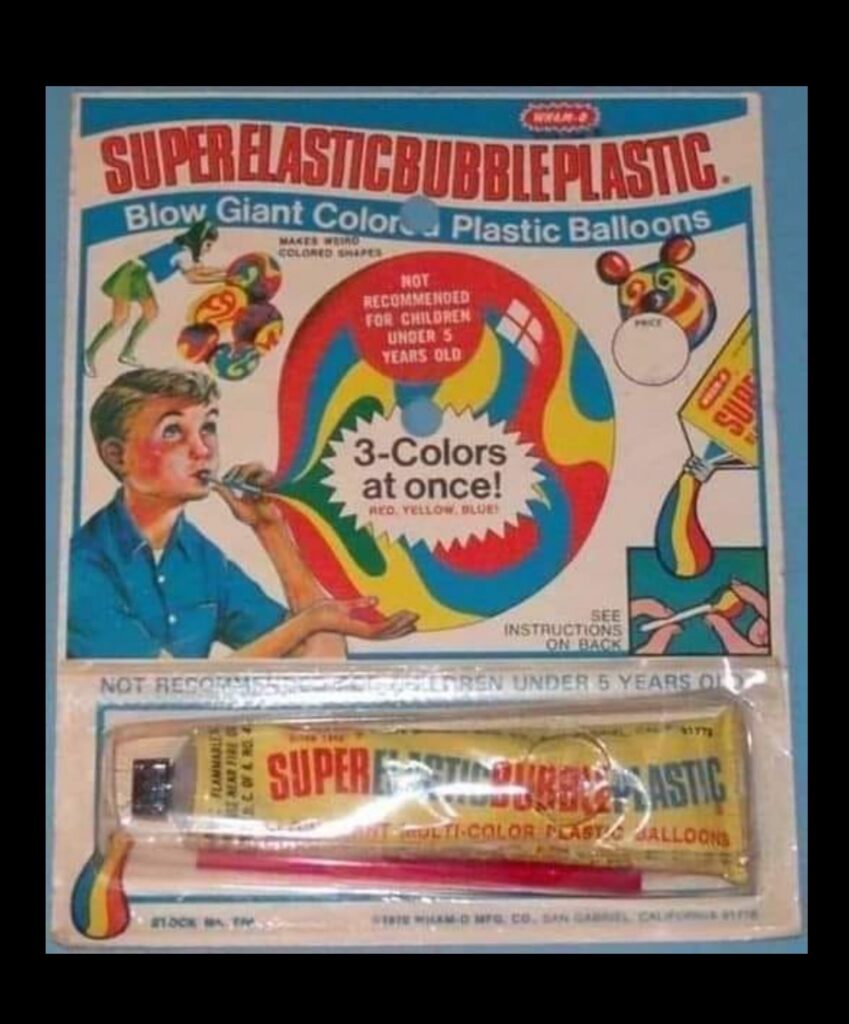
Super Elastic Bubble Plastic
Wham-O produced Super Elastic Bubble Plastic in the early 1970s and it was exactly what it sounds like: a tube of plastic compound that you extruded onto a straw and inflated into a large, wobbly, iridescent bubble. The smell was immediate and aggressive. The bubbles were fragile and spectacular. The compound was not, under any circumstances, something that should have been anywhere near a child’s mouth, which is why the instructions specified to blow through the straw and not inhale. Whether that instruction was universally followed is another matter entirely.
Tech Toys, Such as They Were
By the mid-1970s, electronics were starting to arrive in the toy aisle. Not computers. Not anything that would be recognizable as sophisticated by current standards. But beeping, blinking devices that felt like a genuine glimpse of the future, even if that future turned out to have some significant battery drain issues.
The Close-and-Play Record Player
The Close-and-Play was a portable, child-scaled record player that played 45s. Drop in a single, close the lid, and the music started. It was not high-fidelity. The needle skipped if you breathed on it wrong. The speaker quality was best described as ‘present.’ But it played your records, it was yours, and the ability to control your own music before you were old enough to have a stereo in your room was a meaningful kind of independence.
Cassette Tape Recorders
The cassette tape recorder arrived as a consumer toy item in the early 1970s and immediately became the instrument of two essential Gen Jones childhood activities: recording songs off the radio and recording your own voice to hear what you actually sounded like. The radio recording was an art form that required a steady hand on the record button and a tolerance for the disc jockey talking over the first few seconds of the song. The voice recording was uniformly a disappointment. Nobody sounds the way they think they sound.
Walkie-Talkies
The toy walkie-talkie had a range that was optimistic at best. The sound quality featured a crackle that made every transmission sound like a dispatch from a war zone. The batteries lasted approximately as long as a short film. None of this diminished the appeal of pressing the button, saying ‘over and out,’ and waiting for a response from someone who was standing close enough that you could just talk to them normally. The ritual mattered more than the range.
View-Master
The View-Master predates Gen Jones by about twenty years, introduced in 1939 as a tourist souvenir device. By our childhood years it had become a full-blown toy with licensed reels covering everything from National Geographic wildlife to Disney characters to Sesame Street. The 3D stereo effect was legitimately impressive for something that ran entirely on cardboard discs and the light coming through a window. Flick the lever. Next frame. It was the original portable media device and it never needed charging.
Merlin
Parker Brothers released Merlin in 1978 and it was, by the standards of its moment, a technological marvel. A red, phone-shaped handheld device with eleven glowing buttons that could play six different games: tic-tac-toe, blackjack, a memory sequence game, and a music machine that let you program rudimentary tunes. It beeped and booped. It was the closest thing most Gen Jones kids had to a personal computer, and it sold over five million units, which tells you how hungry the market was for something, anything, with a circuit board in it.
Polaroid Cameras
The consumer Polaroid camera, particularly the One-Step introduced in 1977, arrived when Gen Jones was entering the teenage years. This was not a childhood toy in the strict sense, but for older Gen Jones kids it was a formative piece of technology: take a photo, watch it develop in your hands in sixty seconds, show it to whoever was standing there. No waiting a week for the photo lab. No wondering whether the shot came out. Instant accountability for every terrible haircut, every ill-advised outfit, every moment you would spend the next forty years trying to explain.
The Extinct and the Survivors
Not every Gen Jones toy disappeared. Some of them are still here, still being manufactured, still ending up in the carpet where they will ambush you in bare feet at two in the morning. But a significant number are gone, and understanding which ones survived and which ones didn’t tells you something about what actually makes a toy good.
The Extinct Toys
Clackers are gone, recalled by the CPSC after the acrylic balls demonstrated a tendency to shatter. Lawn darts in their original metal-tipped form were banned in 1988. The Thingmaker, in its original genuinely hot configuration, was redesigned into something considerably less interesting. Super Elastic Bubble Plastic disappeared without much fanfare, presumably because someone eventually read the ingredients list carefully.
The Easy-Bake Oven technically survives, but the 2007 Consumer Product Safety Commission recall of the Fun-with-Food model, and subsequent redesigns, produced something that runs on a heating element rather than a light bulb. It is safer. It is not the same.
Action Jackson lasted only three years. Mrs. Beasley and Chatty Cathy faded as pull-string voice technology stopped feeling novel. The Close-and-Play was made irrelevant by the Walkman and then by everything that came after the Walkman.
The Toy Survivors
Lego is the most obvious survivor, now a global enterprise worth more than most of the toy companies that competed with it in the 1970s. The core product, colorful interlocking bricks that reward patience and spatial reasoning, has not fundamentally changed. The sets are more elaborate, the licensed tie-ins more numerous, and the price points higher by an order of magnitude. The barefoot injury potential remains constant.
Silly Putty, Play-Doh, Slinky, Spirograph, Etch A Sketch, and Frisbee are all still available, all still essentially what they were when Gen Jones got hold of them. They survived because they have something in common: they work on principles that do not go out of date. A Slinky obeys the same physics in 2025 that it obeyed in 1965. A Spirograph produces the same satisfying geometric patterns. Play-Doh still smells exactly like Play-Doh and always will.
Merlin was eventually re-released by Milton Bradley in the early 2000s, confirming that the nostalgia market for beeping handheld devices is more durable than anyone expected.
What It Means
The toys that survived are not necessarily the ones that were most impressive or most sophisticated. They are the ones that had an open-ended quality: you brought the imagination and the toy met you there. Lego bricks do not tell you what to build. Play-Doh does not tell you what to sculpt. A Frisbee does not tell you what game to play with it. The toys that vanished were often the ones with a single function, a single trick, a single point. Once the trick lost its novelty, there was nothing left.
The dangerous ones vanished for obvious reasons, and we are not arguing they should come back. But it is worth noting that a generation of children who played with metal-tipped lawn darts and acrylic ball weapons and open-flame toy ovens turned out functional, arguably resilient, and with a healthy appreciation for the concept of consequences.
Generation Jones Toys: What We Actually Got
Here is the thing about Gen Jones toys that no one mentions in the nostalgia pieces: they were not better because they were simpler. They were better because we were bored, and boredom is one of the most creative forces in human experience.
There was no algorithm deciding what you should play next, and no notification pulling you away from the game. There was just an afternoon, a toy, and the question of what you were going to do with both of them. Sometimes the answer was inspired. Sometimes you ended up sitting in the grass doing nothing in particular, which is also a thing that used to be allowed.
The toys were the starting point, not the destination. A Spirograph was not entertainment. It was a tool. What you did with it was up to you, and if you got bored with it, you went outside and threw the Frisbee, and if you got bored with that, you figured out something else.
That is not a skill anyone can package and sell. But somewhere in a box in a closet, there is a tangled Slinky, a dried-out Silly Putty egg, and maybe a single Lego brick that has survived four decades and two moves. And that brick still works exactly the same way it always did.
Which ones do you still have? Drop it in the comments.
Want the longer version of who we are and what shaped us? Head over to The Definitive Guide to Generation Jones.
Sources
- Generation Jones – Wikipedia
- Jonathan Pontell at GenJones.net
- Generation Jones Looks for Attention – RealClearPolitics, 2008
- The Definitive Guide to Generation Jones
- Generation Jones Explained: The Origin of the Name
PIN IT!


You left out Matt Mason (Matels man in space). He was my go to action figure, and I had the whole set up. My mother threw them out when I went to college and our relationship was never the same😆. I had to buy them back on eBay in my 50s at ten times the price.