

Generation Jones home products didn’t just get discontinued the way a cereal flavor gets discontinued. Whole categories disappeared: the tablets that wouldn’t dissolve, the box that came with a free towel, the stamps you licked and pasted into a book, the man who rang your doorbell selling brushes. This is not a museum piece. It’s an autopsy of the cabinet under the sink, and almost nothing in it survived intact.
Generation Jones (born 1954 to 1965, per the term coined by social commentator Jonathan Pontell) grew up in houses run on products that don’t exist anymore, made by companies that don’t exist anymore, sold through a system that doesn’t exist anymore. A few things made it. Most didn’t. Here’s the inventory, organized by how completely each one vanished.
The Laundry Room Graveyard
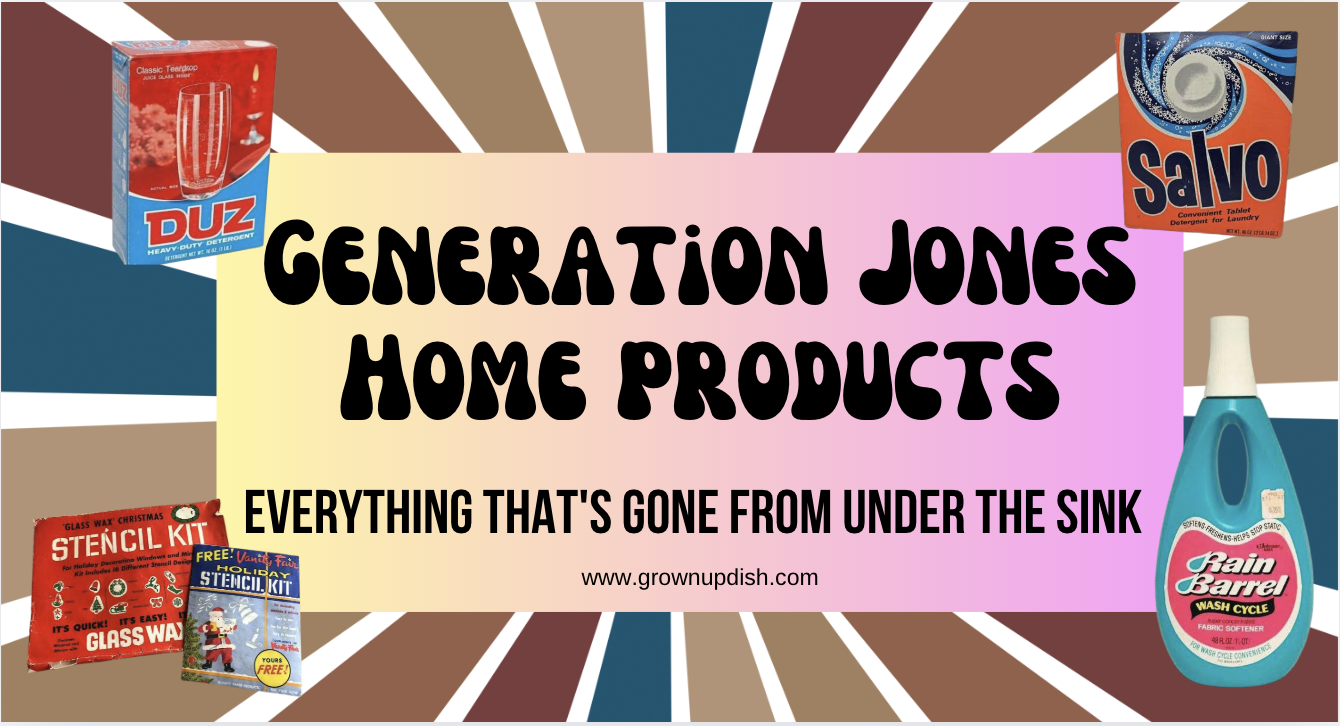
Salvo was Procter & Gamble’s attempt, in the mid-1960s, to put an entire load of laundry detergent into a single compressed tablet you dropped straight into the machine, essentially a detergent pod two generations before detergent pods existed. It didn’t work. The tablets frequently failed to fully dissolve, leaving residue on clothes and in the machine, and P&G pulled the product by the late 1970s. It’s a genuinely rare thing: an idea that was decades ahead of its time and also just didn’t function, which is a worse combination than being ahead of your time and simply unpopular.

Axion arrived from Colgate in 1968 as an enzyme pre-soak, something you added to the wash before the detergent to break down protein stains. It made sense for exactly as long as it took P&G and everyone else to start putting enzymes directly into their regular detergent, at which point a separate pre-soak step became pointless. Axion was gone by the late 1970s, killed by the very ingredient it had introduced to the category. Rain Barrel fabric softener ran ads through the same decade promising rainwater-fresh softness right in the wash cycle, going up against Downy and Sta-Puf, and simply faded out of the market without much of a story attached. Cling Free dryer sheets held on longer, well into the 1980s, before disappearing too, leaving Bounce standing as the last one standing in that particular fight.
The Detergent Box That Came With a Prize
In the early 1950s, Duz detergent (and its competitor, Bonus) started tucking a genuine piece of dinnerware inside every box: a plate one month, a bowl the next, a glass tumbler after that, all part of the same Golden Wheat pattern. Buy the largest box size and you got an actual bath towel instead of a dish. Families reportedly bought detergent by the case just to complete the set, which tells you something about how thin the line was between grocery shopping and a slot machine. The premiums stopped by the late 1960s, and once the free dishes disappeared, so did the brands. Nobody was buying Duz for the soap.

Detergent’s other marketing trick was even stranger, and it’s still with us in name only. Procter & Gamble’s Oxydol sponsored a radio drama called Ma Perkins from 1933 into the 1950s, aimed squarely at homemakers doing laundry during the day. The show was so closely tied to its sponsor’s product category that the entire genre took its name from it: soap opera. Every soap opera that ran on television for the rest of the century, including the ones we watched instead of doing homework, is named after a laundry detergent most of us never used.
The Window and Surface Products That Vanished
Glass Wax cleaned windows, but its real business was Christmas. Starting in the early 1960s, the company sold stencil kits, cardstock cutouts of snowflakes, Santa’s sleigh, and holly wreaths, that you’d dab with a sponge dipped in the pink liquid, which dried to a frosted white finish on the glass. It was a whole seasonal ritual built around a cleaning product, and it disappeared along with the company that made it, Gold Seal, which went out of business decades ago. Janitor in a Drum had a less sentimental job (an all-purpose cleaner strong enough for genuinely dirty jobs) and a name that confused every kid who ever read it on the shelf. It never technically vanished, but growing discomfort with harsh chemical cleaners pushed it to the margins, and the version still findable today isn’t as strong as what was under your sink in 1975.

Spic and Span has the strangest origin story of the bunch: it was invented in 1933 by two Michigan housewives, Bet MacDonald and Naomi Stenglein, who mixed up a scouring powder out of ground glue, sodium carbonate, and trisodium phosphate in their own kitchens and started a company to sell it. It passed through Procter & Gamble’s hands for decades as the go-to floor and wall cleaner in nearly every household. It technically hasn’t been discontinued (it’s still sitting on a shelf somewhere at Home Depot or Ace Hardware), but the trisodium phosphate that made the original formula so effective on grease also made it an environmental problem, and by the time it was reformulated to drop the ingredient, most of us had already replaced it with something else and stopped noticing it was gone.

The Reward Economy Built Around Housework
S&H Green Stamps were handed out at the supermarket, the gas station, and practically anywhere else a purchase happened, from the 1930s through the 1980s. You licked them, pasted them into a collector’s book, and once you’d filled enough books, traded them in at a redemption store or catalog for actual merchandise: toasters, lamps, whatever the points would cover. It was a second currency built entirely on top of ordinary household shopping, and it ran for decades before fading out through the 1990s and 2000s. The company behind it didn’t formally shut down until 2020, by which point most of us had forgotten trading stamps had ever been a real financial habit and not just something our grandmothers did.
The Salesman at the Door
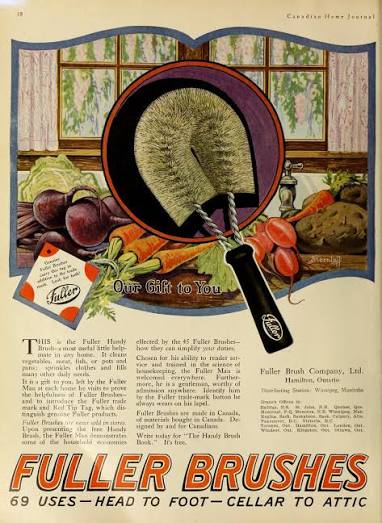
Before any of these products showed up on a shelf, a lot of them showed up at your front door. The Fuller Brush Man sold door-to-door exclusively until 1985, with a single rep expected to ring as many as 60 doorbells a day. Stanley Home Products took the same catalog of cleaning goods and, starting in 1931, moved it into the living room instead, inventing the home sales party where one saleswoman demonstrated products to a room full of invited neighbors at once. That exact format later trained Brownie Wise, who used it to save Tupperware, and Mary Kay Ash, who built an entire cosmetics empire on it. The products themselves matter less here than the fact that an entire sales channel, a stranger at the door or a neighbor’s living room turned into a showroom, simply stopped existing as a mainstream way to buy household goods.
The Ones That Made It
A few things from the same era are still on shelves, which makes them the exception, not the rule. Ziploc bags, test-marketed by Dow Chemical in 1968, are still the default answer to “how do we store this.” Bounce dryer sheets, patented in 1969 and rolled out nationally in 1975, outlasted Cling Free, Rain Barrel, and every other static-cling competitor from the decade. Scrubbing Bubbles, introduced by Dow in 1972, is still promising a talking foam that does the scrubbing for you. All three survived by solving a genuinely ongoing problem instead of running on a premium, a jingle, or a sales gimmick, which turned out to be the actual difference between the products in this section and everything above it.
Palmolive dishwashing liquid belongs in this section too, though its story runs backward from most of the others. The name dates to 1898, when B.J. Johnson formulated a bar soap out of palm and olive oils and named it accordingly, and it was the best-selling soap in the world within a few years. The liquid dish soap most of us actually grew up with didn’t arrive until 1966, decades after the bar soap had already made the company’s fortune.

That same year, Colgate-Palmolive introduced Madge, a fictional manicurist played by actress Jan Miner, who’d soak a client’s fingertips in a bowl of what she claimed was lotion, then deliver the reveal: “you’re soaking in Palmolive.” The campaign ran for 27 years, until Madge finally retired in 1992. The soap itself is still sold today, a genuine survivor by the definition used everywhere else in this article. Madge isn’t walking through anyone’s salon door again, though, and neither is the entire premise that a stranger would grab your hand and dunk it in dish soap without asking first.
What’s Actually Under the Sink Now
Almost nothing from that decade’s cabinet made it out intact. Some products were solved out of existence by their own industry. Others were killed by the thing that made them fun in the first place, once the free dishes and the stencil kits stopped coming. Some didn’t fail so much as the entire way we bought them; a stranger at the door, a neighbor’s living room, a book of stamps, simply stopped being how anyone shopped. That’s the real shape of Generation Jones home products: not a shelf of old brands, but a whole system that’s gone.
Tell us in the comments which one you had, which one you still miss, and what we left out. And follow for more content made for the generation that that everyone forgets about.
Want a deep dive of who we are and what shaped us?
The Definitive Guide to Generation Jones
Sources
- Generation Jones – Wikipedia
- Jonathan Pontell at GenJones.net
- Generation Jones Looks for Attention – RealClearPolitics, 2008
- The Definitive Guide to Generation Jones
- Generation Jones Explained: The Origin of the Name
PIN IT!